

Core HR Agent
How Long Should Expense Approval Actually Take? 2026 Benchmarks for Modern Teams
- 11 February, 2026
- Max 05 min read
 Ami Tran

Table of Content
For years, expense approval has been shaped by a widely accepted internal norm: reimbursements were often handled on multi-day or multi-week cycles. These timelines reflected internal finance processes, not employee needs.
Today’s employees live in a world of instant confirmations, real-time payments, and same-day financial visibility. When personal banking apps settle transactions in seconds, waiting weeks for an expense claim feels less like a process delay and more like organizational friction. As a result, expense report processing time benchmarks are no longer just an internal finance metric; they are a visible signal of how modern, responsive, and employee-centric a company truly is.
This shift has compelled finance leaders to reassess the role of expense approvals within the broader employee experience. This blog looks at why “fast” is no longer enough in 2026, how approval benchmarks differ across manual, automated, and agentic workflows, common friction points slow teams down, and how touchless, agentic AI approvals are becoming the new standard.
Redefining Expense Approval Speed in 2026
See how modern benchmarks are shifting from manual cycles to touchless, AI-driven approval workflows.
The 2026 Reality: Why Fast Isn’t Good Enough Anymore
For a long time, improving the expense approval cycle time meant making internal processes more efficient. If approvals moved faster than before, finance teams considered it a success. Speed was measured against past performance, not against how employees actually experienced the process.
In 2026, that comparison has changed. Employees now compare expense reimbursements to everyday financial experiences like instant transfers and real-time payment apps. When money moves instantly elsewhere, waiting days for approval feels outdated and frustrating, even if the process is technically “faster” than before.
As a result, reimbursement speed is no longer just an operations metric. The average time for expense reimbursement in 2026 is increasingly seen as a signal of how responsive, transparent, and employee-focused a company is, directly shaping trust and long-term retention.
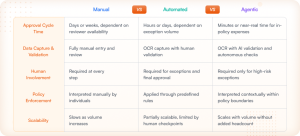
Benchmarks: Manual vs. Automated vs. Agentic
Not all expense workflows are designed the same. In 2026, approval speed is largely determined by how much of the process still depends on human intervention versus how much can run end‑to‑end without manual handoffs. The differences between manual, automated, and agentic approaches show up clearly when you compare cycle time, effort, and consistency.
3 Factors Killing Your Approval Speed
Slow expense approvals are rarely caused by a single failure. In most organizations, delays come from repeated friction points embedded in everyday workflows. These issues compound over time, turning routine expense approvals into a persistent bottleneck.
Below are 3 common factors that consistently slow down expense approval cycles across teams:
Vague submissions that trigger unnecessary rejections
A large share of expense rejections that inflate expense approval cycle time is not caused by fraud or policy abuse, but by missing or unclear information at the point of submission. When descriptions are vague, receipts are incomplete, or categories are unclear, reviewers cannot confidently approve the expense on the first pass.
This slows the approval cycle because:
- The same expense is sent back and resubmitted multiple times
- Managers and finance teams must re-open and re-review the same claim
- Each clarification adds idle waiting time before the expense can move forward
Human-dependent validation after capture
Even when expenses are submitted digitally, many workflows still depend on humans to validate data after capture, directly increasing the cost of manual expense approval. OCR accuracy can capture receipt data effectively, but approvals often pause while reviewers verify fields, reconcile totals, or fix small mismatches.
This slows the approval cycle because:
- Expenses wait in validation queues before anyone can approve them
- Minor data issues require rework instead of flowing through automatically
- Approval speed becomes limited by reviewer availability, not policy complexity
Approval logic that treats all expenses the same
Many expense workflows apply the same approval path to every claim, regardless of risk, amount, or policy compliance. Low-risk, in-policy expenses are routed through the same multi-step approvals as complex or exceptional cases.
This slows the approval cycle because:
- Simple expenses wait behind complex cases that require more scrutiny
- Managers are asked to review items that do not require judgment
- The system cannot approve low-risk expenses automatically, even when rules are clear
The ROI of Instant: What You Actually Save
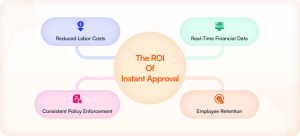
Instant expense approval delivers measurable financial returns across labor costs, operational efficiency, data quality, compliance risk, and employee retention. When approval cycles compress from days to minutes, organizations capture concrete savings that compound as transaction volume grows.
Reduced Labor Costs
Manual expense processing requires substantial human effort across data entry, validation, approval routing, and reconciliation. Finance teams spend hours each week chasing receipts, answering clarification questions, and managing approval queues. Automation redirects this capacity toward strategic work that drives business value.
Example: A finance team processing hundreds of expense reports monthly can reduce processing time by two-thirds, freeing dozens of hours for forecasting, analysis, and decision support instead of routine review work.
The result: Direct labor cost reductions that improve expense management efficiency by eliminating non-value-added coordination and allowing organizations to scale processing capacity without proportional headcount growth.
Real-Time Financial Data
Delayed approvals force finance teams to operate with incomplete information throughout the month. Unapproved expenses remain outside the general ledger, requiring manual reconciliation during close and forcing teams to work from estimates that must later be adjusted.
Example: When expenses are submitted and approved the same day post immediately to financial systems, and finance teams eliminate the accumulated backlog of pending items that traditionally require hours of reconciliation work at month-end.
The result: Close cycles become faster and more predictable as real-time expense reconciliation eliminates manual matching work, reduces estimation variance in monthly reporting, and gives leadership accurate financial visibility throughout the period instead of only after close.
Consistent Policy Enforcement
Manual reviews introduce interpretation variability across different reviewers, especially under time pressure or high workload. This inconsistency creates compliance gaps that surface during audits and increases the risk of missed policy violations or delayed corrections.
Example: Standard business expenses like mileage reimbursements and per diem claims receive automatic approval using identical validation rules every time, while only unusual patterns or high-risk combinations escalate for human judgment.
The result: Policy application becomes standardized across all submissions, audit trails contain complete decision logic for every approval, and organizations reduce both the frequency of errors and the time spent correcting them after the fact.
Employee Retention
Expense reimbursement directly affects employee satisfaction and retention decisions. When employees must cover business costs from personal funds while waiting days or weeks for reimbursement approval, frustration builds—particularly for employees who travel frequently or incur regular business expenses.
Example: Sales representatives and consultants who submit travel expenses receive same-day approval with visible status tracking instead of waiting weeks with no information about where their request sits in the approval queue.
The result: Employees experience predictable, transparent reimbursement with minimal financial friction. This directly reduces the impact of slow reimbursements on employee retention, as research shows that regular delays in reimbursement significantly influence employees’ decisions to seek opportunities elsewhere.
Final Thoughts
The delays and friction explored in this blog, slow approvals, repeated rework, manual validation, and employee frustration, are not isolated issues. They point to a single underlying problem: expense workflows that still rely too heavily on human coordination for routine decisions.
When everyday expenses sit between submission and approval, waiting for manual intervention, finance becomes a bottleneck rather than an enabler. The way forward is not adding more tools, but redesigning workflows so that routine, in-policy execution can run continuously and predictably.
With agentic AI handling standard expense approvals alongside finance teams, organizations can shorten approval cycles, improve data quality, and scale operations without increasing workload or headcount.
Ready to identify where friction exists in your expense approval process? Explore how Blazeup helps teams move from manual coordination to AI-driven expense workflows.
Frequently Asked Questions
Blazeup is an AI Business Operations Platform built on intelligent AI Agents. Instead of running HR, Finance, ITSM, CRM, and Projects on separate tools, Blazeup unifies everything into one system with one login.
Unlike traditional HRMS or ERP software, Blazeup’s AI Agents don’t just store data—they coordinate workflows, connect teams, and execute work automatically, so operations move faster with less friction.
👉 Explore the platform on Agents Overview
Recent Blogs
Learn how AI Agents automate tasks, unify your data, and surface insights that drive real results.


